Hi, this is Specially Appointed Assistant Professor Tao!
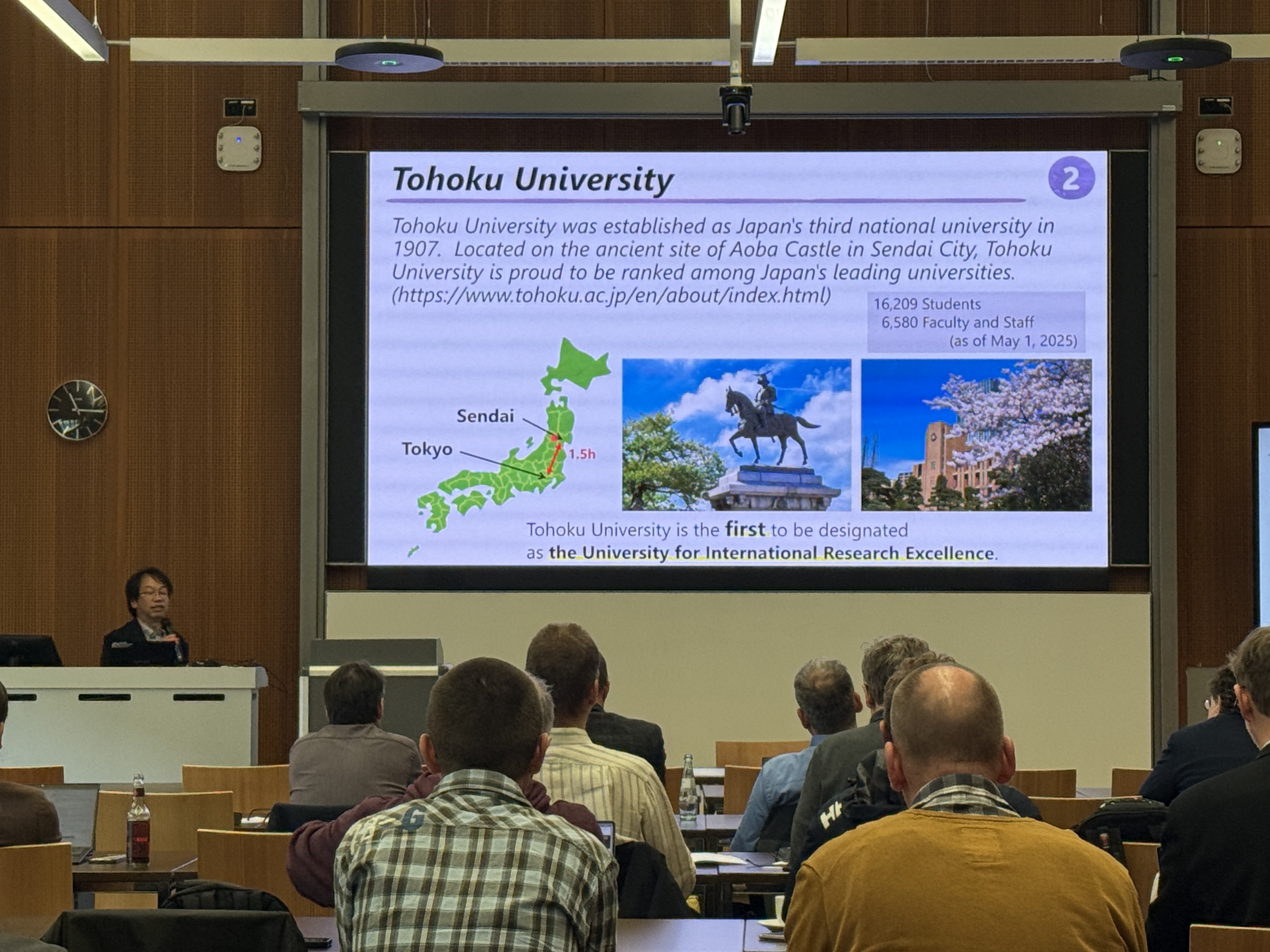
From May 18 to 20, 2026, I attended the 37th NEC User Group Meeting, NUG Society Meeting XXXVII 2026, held at the Information Technology Center of the University of Cologne (ITCC) in Cologne, Germany. The NEC User Group (NUG) is an international meeting where users, operators, and developers of NEC supercomputers and high performance computing (HPC) systems share the latest technologies, operational experience, and research results.
From our laboratory, Prof. Takizawa and I gave talks. Prof. Takizawa spoke on AI-assisted programming in his talk titled “Towards AI-assisted Programming at the Tohoku University Cyberscience Center.” He introduced HPC user support activities at the Tohoku University Cyberscience Center and discussed the potential of large language models (LLMs) for code understanding, performance optimization, semantic equivalence verification, automated debugging, and performance bottleneck analysis. I gave a talk titled “A Runtime Prediction Model for Capacity Planning in Shared-Backend LLM Multi-Agent Social Simulation,” introducing AI-agent social simulation for tsunami evacuation. Based on the supercomputer AOBA and ExpressHPC, an urgent computing framework that connects multiple supercomputers, I discussed how to predict the runtime of large-scale LLM multi-agent simulations and use it for capacity planning in city-scale evacuation simulation.
The meeting also covered a wide range of topics, including NEC’s HPC and Research Information Infrastructure (HPC/RII), next-generation vector systems, RISC-V and vector extensions, GPU resource utilization, integration of HPC and AI services at RWTH Aachen University, Slurm cluster operation, storage research at the Center for Computational Sciences, University of Tsukuba, and high-performance fluid dynamics algorithms at the University of Cologne. Through this meeting, I was reminded that the future development of HPC depends on the combined progress of hardware, software, user support, and AI applications. I hope to apply the insights gained from this meeting to my future research and to user support at the Cyberscience Center.